
- News
- City News
- chennai News
- Domestic abuse: More women speak up, but is govt listening?
Trending
This story is from July 18, 2018
Domestic abuse: More women speak up, but is govt listening?

Representative image
While many like them choose to or are forced to live with their abusive husbands, state records have shown an encouraging trend: More women are reaching out for help.

While more women are opening up, the state finds itself ill-equipped to help them. Less than half of the petitions received last year translated into police complaints, the rest were ‘resolved’ through counselling, which, petitioners’ say, involves sending them back into abusive marriages. On an average, less than 500 were registered as police complaints in each district.
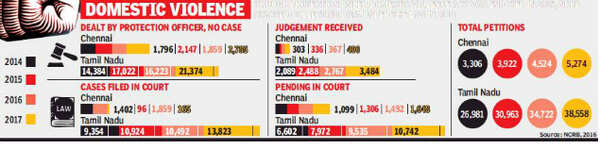
Prasanna Gettu, founder of International Foundation for Crime Prevention and Victim Care (PCVC), said the climb in the number of domestic violence cases being reported was significant. “It is the highest in Chennai probably because of awareness. But are these women getting help?” she said.
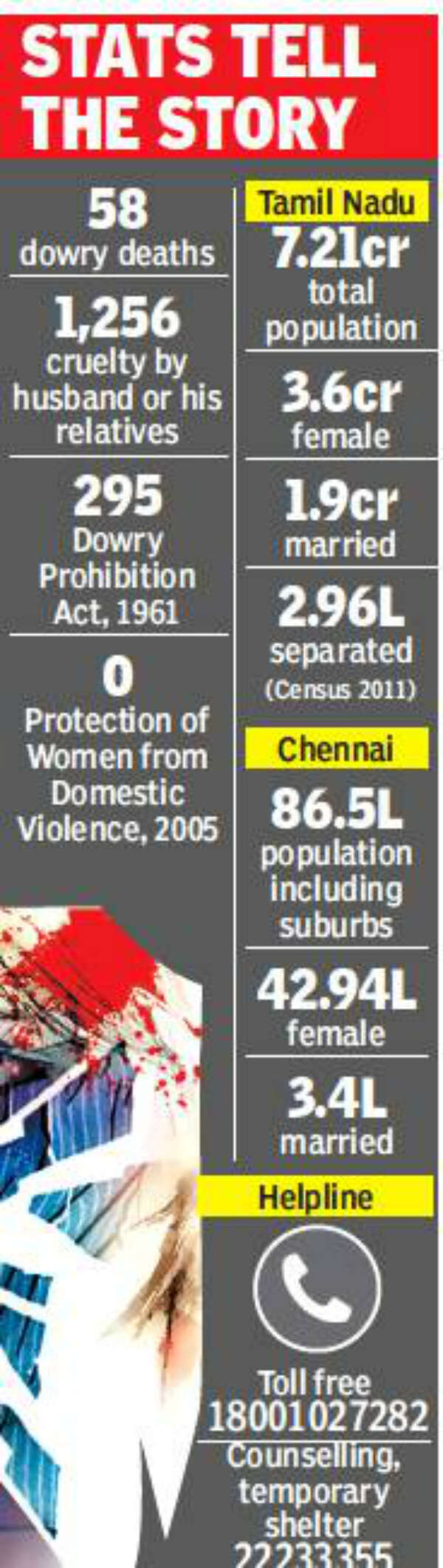
Chennai, for example, has only two protection officers for survivors of domestic violence. Both of them ‘resolved’ 2,785 disputes without filing a case under the Protection of Women from Domestic Violence Act, 2005. “The cases referred to them are usually of serious nature like if there is a threat to the woman’s life or a restraining order is required,” said Prasanna.
And this reflects in their counselling. Amrutha*, a 32-year-old mother of two, said she approached police after fleeing from her abusive husband two years ago. “They didn’t register a case and asked me to think of my children and go back,” she said. The second time she approached police, she was referred to a protection officer. Amrutha now lives separately.
Though the protection under domestic violence act was enacted in 2005, the NCRB started collecting data under the law in 2014. Even now, data collected by NCRB includes only criminal violations of court orders. NCRB data shows TN had zero cases in 2016. The same year, the social welfare department received 34,722 domestic violence cases.
Officials, doctors and non-governmental organisations say although women are slowly opening up , they are reluctant to report domestic violence to authorities. “Financial situation, stigma, future of their children and predatory elements within the community deter them,” said Dr Shanthi Gunasingh, head of the Government Hospital for Women and Children in Egmore.
Another flaw in implementation of the law is that there is no uniform protocol for service providers who in this case are mostly NGOs and have no link with the police or with protection officers. Only a minority reach the courts. Even here they are let down. “Under the Act, the case should be closed in 60 days, but we have cases prolonging for the past three years,” said advocate Sudha Ramalingam.
Director of social welfare V Amuthavalli said the government was introducing a series of measures to help these women. “We are going beyond counselling to helping them through the legal process and empowering them through training programmes,” she said. “But we still have a long way to go especially in integrating multiple services for these women,” she added.
End of Article
FOLLOW US ON SOCIAL MEDIA










Hot Picks
TOP TRENDING
Trending Stories
In City
Entire Website
- 'Assigned task was not hers': Work pressure at EY Pune kills CA daughter from Kerala
- 'Stupid statement': Ex-Pakistan cricketer Basit Ali blasts Australian bowler for predicting 5-0 victory over India in Border-Gavaskar Trophy
- EXCLUSIVE | My sights are set on hitting the bullseye and changing the colour of medal at Los Angeles Olympics: Manu Bhaker
- Telangana to scrap 15-year-old vehicles from January 1
- What MS Dhoni said to Yuvraj Singh after he hit Stuart Broad for 6 sixes in 2007 T20 World Cup
- 'Attempt to polish your failed product': Nadda's response to Kharge's letter to PM Modi
- Pannun files civil lawsuit in US against GOI, Doval and others, seeks damages
- Atishi to take oath as Delhi chief minister on September 21, confirms AAP
- India gets ready for White Revolution 2.0 to strengthen its dairy sector, SOPs to be out tomorrow
- No recognition of Israel without Palestinian state: Saudi crown prince
- 'Unwarranted': India reacts sharply to US court summons over Pannun's lawsuit
- BJP minister booked for calling Rahul Gandhi 'number one terrorist'
- Atishi has five months to prove herself, what will she do?
- FATF praises India's efforts to tackle terror financing: Why it matters
- Pak doing 'balle-balle' over Cong-NC alliance in J&K, says PM Modi
- 1st Test: Centurion Ashwin, Jadeja take India to 339/6 at stumps on Day 1
- Will this man who wants to ‘cancel’ Adani become Lanka president?
- Accenture delays promotions globally, after denying salary hikes to employees in India
- When Kohli played a Ranji match hours after his father's demise
- Sandip Ghosh's medical practitioner registration cancelled

Popular Categories
Hot on the Web
Top Trends
Trending Topics
Living and entertainment
Latest News
Centre to examine EY India worker’s demiseWWE NXT Viewership Skyrockets on 9/17 following CM Punk's appearanceGoogle offers to sell part of its advertising technology business, but why European Union publishers are not happy with the proposal'Unwarranted, unsubstantiated': India reacts strongly to US court summons over pro-Khalistani terrorist Pannun's lawsuit over 'assassination bid'Shraddha Kapoor channels Sridevi's elegance in her latest photoshootKMAT 2024 admit card released at kmatindia.com, exam on Sept 22: Direct link to download hereFoods to include in the Monsoon diet according to AyurvedaDelhi housing society’s letter on ‘receiving too many parcels in a day’ goes viralThe man who wants to 'cancel' Adani from Sri LankaMumbai railway official loses Rs 9 lakh as he dials ‘0’ from his phone; presented before 'judge'On way to Gurgaon pub, 5 students suffer injuries after 'rented' car collides with railing at Delhi's Geeta Colony flyoverHC directs CBFC to decide on 'Emergency' certification by September 25: “You must have the courage to say this film cannot be released”OTET Answer Key 2024 released at bseodisha.ac.in, raise objections till Sept 28: Subject-wise direct links hereThalapathy Vijay’s GOAT is inching towards Rs 15 crore mark in HindiSalman Khan makes a dapper appearance at the Mumbai airportThrowback: When Neetu Kapoor revealed about her playful competition with Alia Bhatt over Raha's first wordsBanks to play important role in making in Viksit Bharat : FM SitharamanTelangana MSME policy: Focus on womenpreneurs, Rs 100 crore Yantram Fund for tech upgrade
Copyright © 2024 Bennett, Coleman & Co. Ltd. All rights reserved. For reprint rights: Times Syndication Service